|
Tile Layout
Orientation
Another task you must accomplish is to determine the layout of
your tile. The goal of tile layout is twofold: identify problem areas and
ensure that the tiles you must cut land on the edges. Common problems are rooms
that are out of square and walls that are not straight. The most common layout
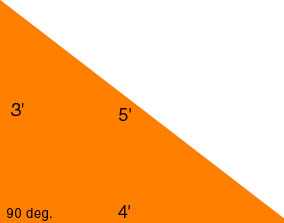
tool is the 3-4-5 triangle.
The 3-4-5 shuffle
There are many ways to layout a floor. Rooms with many obstructions may
require more sophisticated methods than described here. Professionals use a
"floating" 3-4-5 triangle marked on the floor to adjust their layouts.
Fortunately, an easier way exists that provides excellent results. Here's
how:
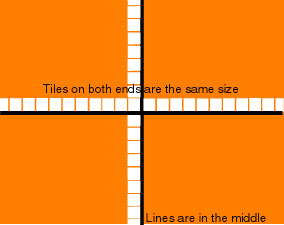
1. Using a measuring tape, mark the midpoint of two opposite walls. Use a
chalk line to snap a
line between the two marks you just made.
2. Measure the line you just
snapped to find and mark the midpoint of the line.
3. Using a carpenter's
square, mark a perpendicular line from the midpoint of the original line.
Extend it as far as possible in both directions and use a chalk line to snap a
line along it.
4. What you have now is the middle of any room that has any
kind of normal layout.
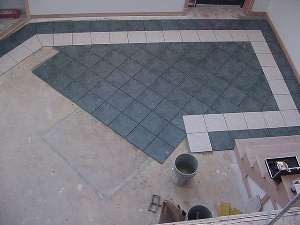
5. Use these lines to dry-fit your tiles (both
directions) in place. Your goal is to balance the cuts that you will have to
make along opposite walls. Based on what you find, you may have to adjust your
layout line a few inches to balance the tiles along the walls.
|
|